The Sierpinski triangle, Wikipedia, is a fractal with the overall shape of an equilateral triangle subdivided recursively into smaller equilateral triangle while the Sierpinski carpet is a plane fractal first described by Waclaw Sierpinski with the overall shape of a square. The scaling factor for the carpet has been shown to be 1/3 the size of previous square, while its Hausdorff dimension of D = log 8/log 3 ≈ 1.8978.
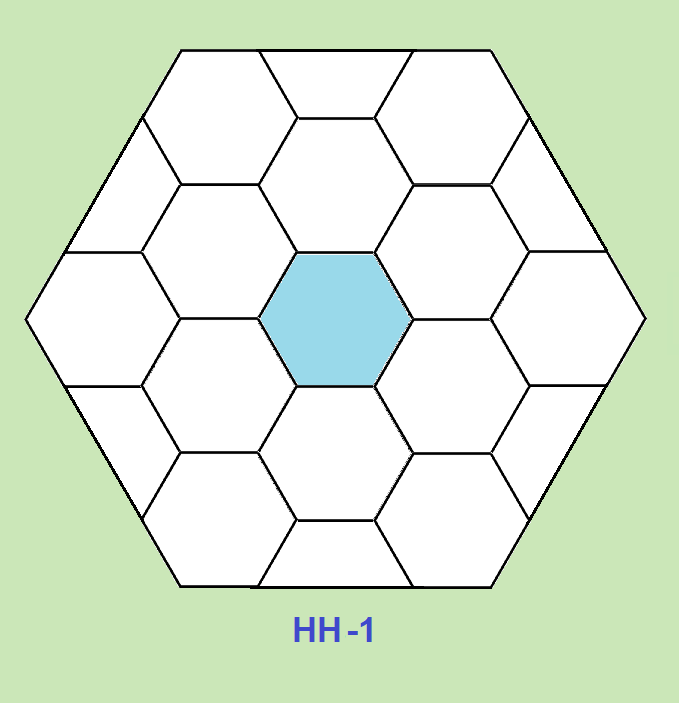
A hexagon carpet has been described in chaos fractals arcadia. However, this fractal is unlike the one constructed on this webpage, or structually similar to the original Sierpinski carpet. The one constructed here while similar to the original Sierpinski is composed of all hexagons, including the holes. To start sixteen hexagons, 13 whole and six half hexagons are tesselated within a larger hexagon, with a hole at the central hexagon as shown, where a total of 16 hexagons (if one considers two half hexagons as a full one) within a larger hexagon:
The scaling factor for this carpet is 1/4 where the ratio of the side of the smaller hexagon to the large is 1:4. The area of HH-1 is equal to 15/16 = 0.9375 with a Hausdorff dimension of D = log15/log4 ≈ 1.9534. The next step is to convert HH-1 into HH-2, where all full hexagons have a smaller blue hexagon of 1/4 of its size at their center, while the half hexagons have one that's half blue.
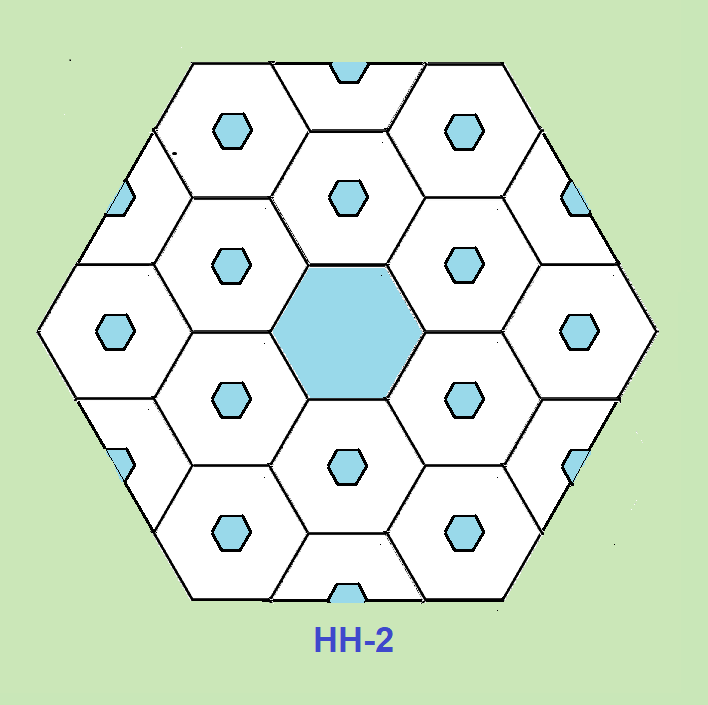
Using the Droste effect, the effect of a picture recursively appearing within itself, we can use recursion to fill in the large hexagon with smaller and smaller blue hexagons as shown:
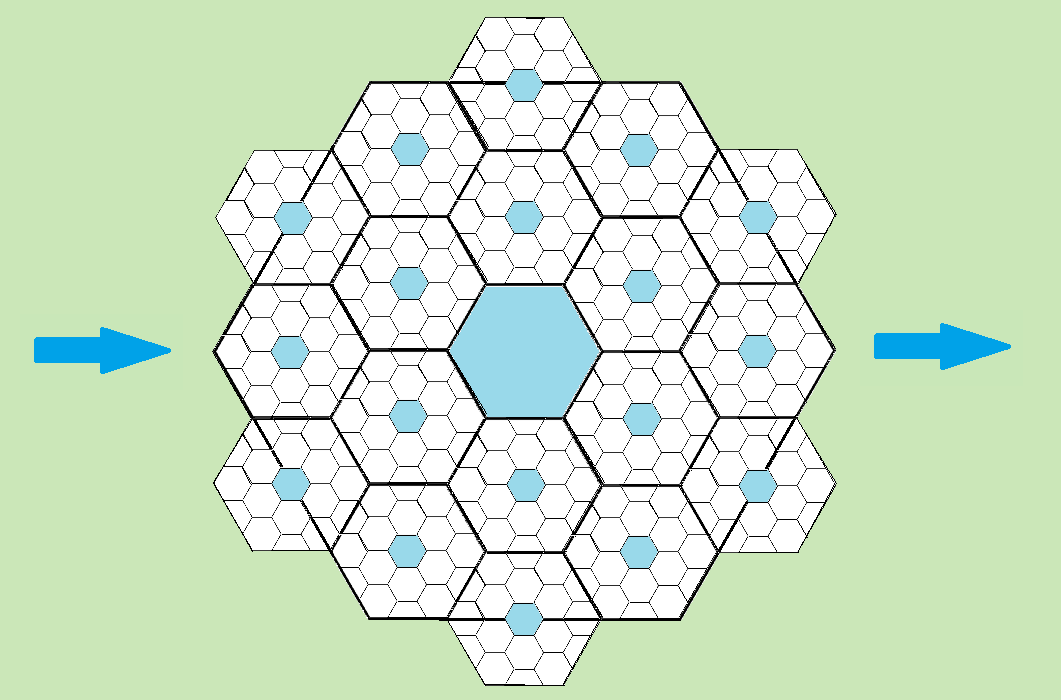
We obtain an intermediate whose six external half hexagons, (i.e., those half hexagons outside the perimeter of the large hexagon) which are deleted as well as all the small non-blue hexagons (i.e., those that were generated during the recursion) to afford HH-2. One may proceed via two possible routes if none of the internal black hexagons are absent.
Performimg a third recursion on HH-2, clipping off the half hexagons and deleting all the small non blue hexagons as before affords HH-3. And lastly performing a fourth recursion, clipping and deleting affords HH-4.
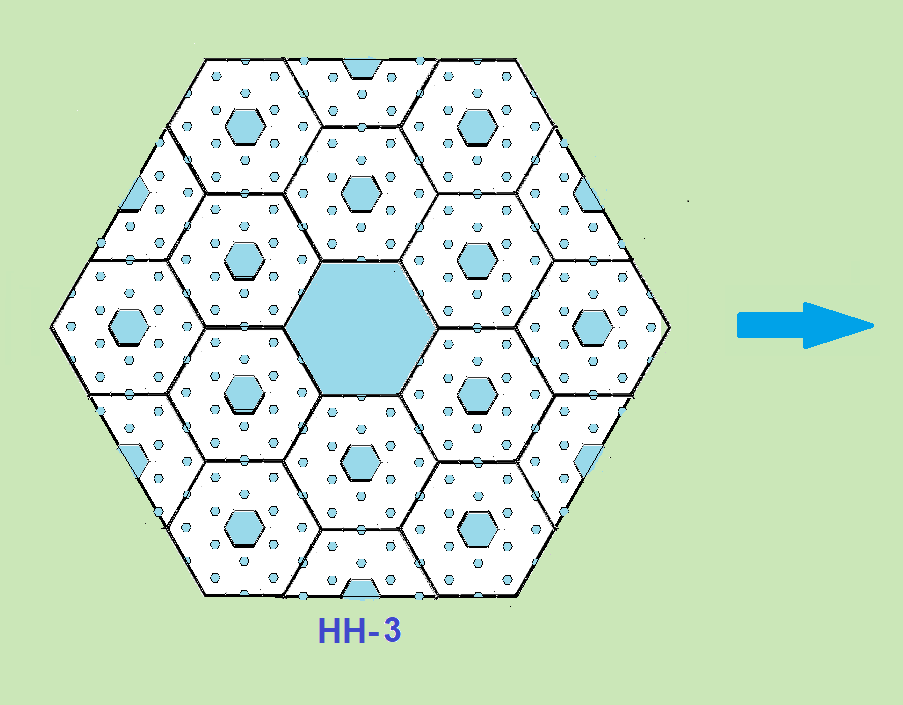
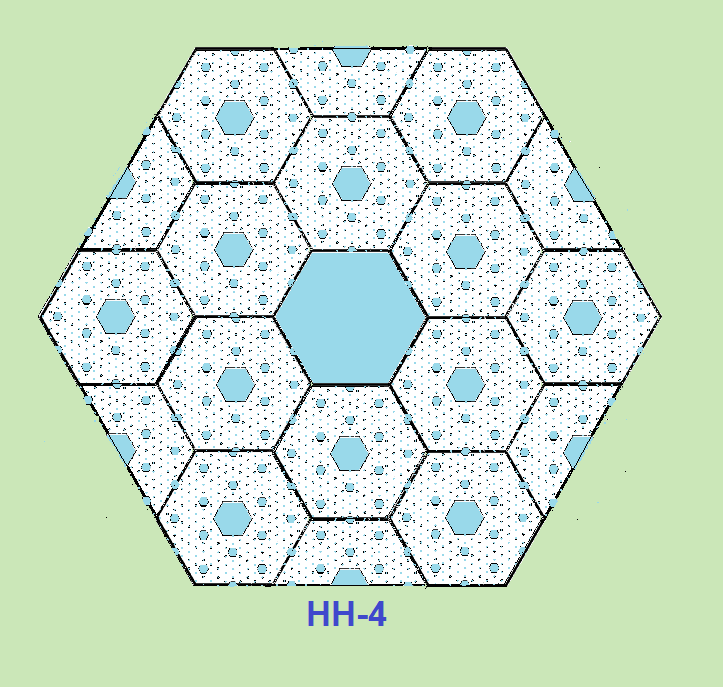
We can blow up HH-3 and HH-4 so as to increase the image resolution of the fourth recursion of the figure above. Moreover, I'm not deleting the 15 total, internal black hexagon, outlines, although they may be so that only the blue hexagons are present. In addition, one may change the orientation of HH-4 by 60° so that all smaller internal hexagons are oriented horizontally.
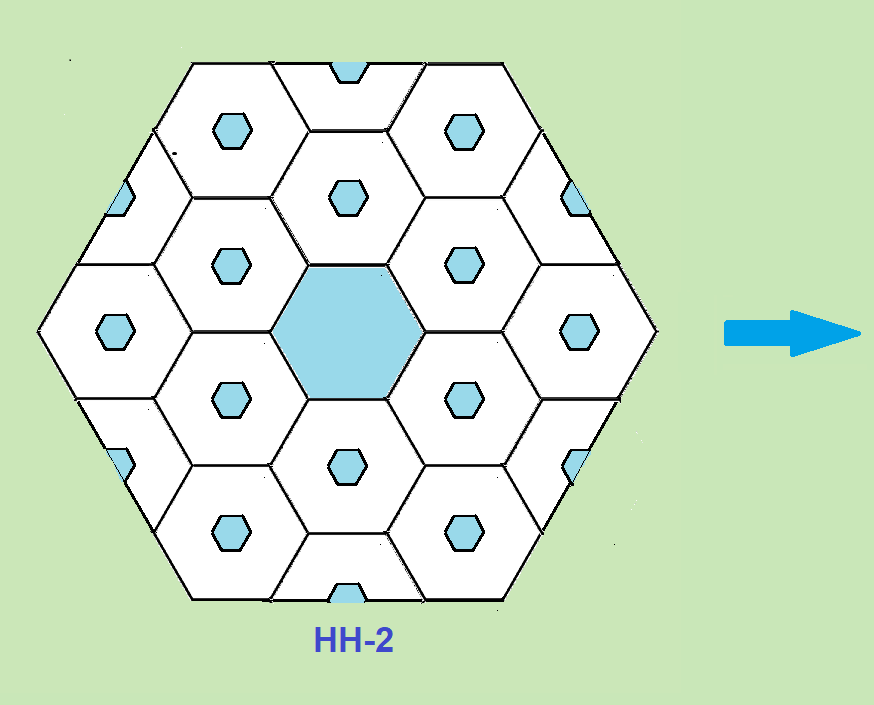
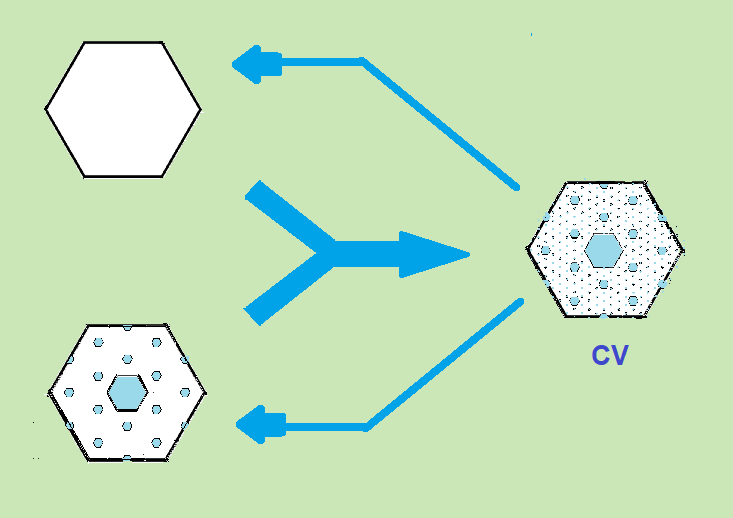
As a final note using only one of the internal hexagons: The same product, CV, can be generated via two different routes. One can add the current, Droste recursion version (CV) to either an empty hexagon (of which there are 15 in total) or directly to the previous recursion version (also 15 hexagons) as shown. The first is inserted cleanly, the second requires that all the hexagons of the current Droste recursion version superimpose onto the hexagons of the previous version.
Go back to homepage.
Copyright © 2026 by Eddie N Gutierrez. E-Mail: enaguti1949@gmail.com