This is a coninuation of of the induction proofs Part VIIc and Part VIId for √n(−(x ∕ y) + x + y).
It has been shown (Between_two_Rational_Numbers on Wiki) that between two real numbers (ℝ) there exists an irrational number. Accordingly, it will be shown here that between two adjacent natural numbers (ℕ) there exists an irrational number (ℝ\ℚ). In addition, an arithmetic progression or sequence of irrational numbers will be generated in this section where there are two common differences (Δ1) and (Δ2) between the irrational numbers generated from Part VIIb for
The sequence derived from the equation √n(−(x ∕ y) + x + y) is shown in Tables I and II where the values of n range from 1 to 14, while those of x and y range, respectively, from 1 to 28 and 2 to 29. The differences (Δ1) and (Δ2) between the irrational numbers are, respectively, about 0.5 and 1.5 where Δ2 corresponds to the end of one Δ1 to the start of the next Δ1 in the sequence, and approach these values as x and y increase without bound. The value for each √n(−(x ∕ y) + x + y), is calculated to 6 decimal places, is irrational and each of these values indeed falls between their respective consecutive natural numbers. In addition, the fourth column heading is SQRT = √n(−(x ∕ y) + x + y).
|
|
|||||||||||||||||||||||||||||||||||||||||||||||||||||||||||||||||||||||||||||||||||||||||||||||||||||||||||||||||||||||||||||||||||||||||||||||||||||||||||||||||||||||||||||||||||||||||||||||||||||||||||||||||||
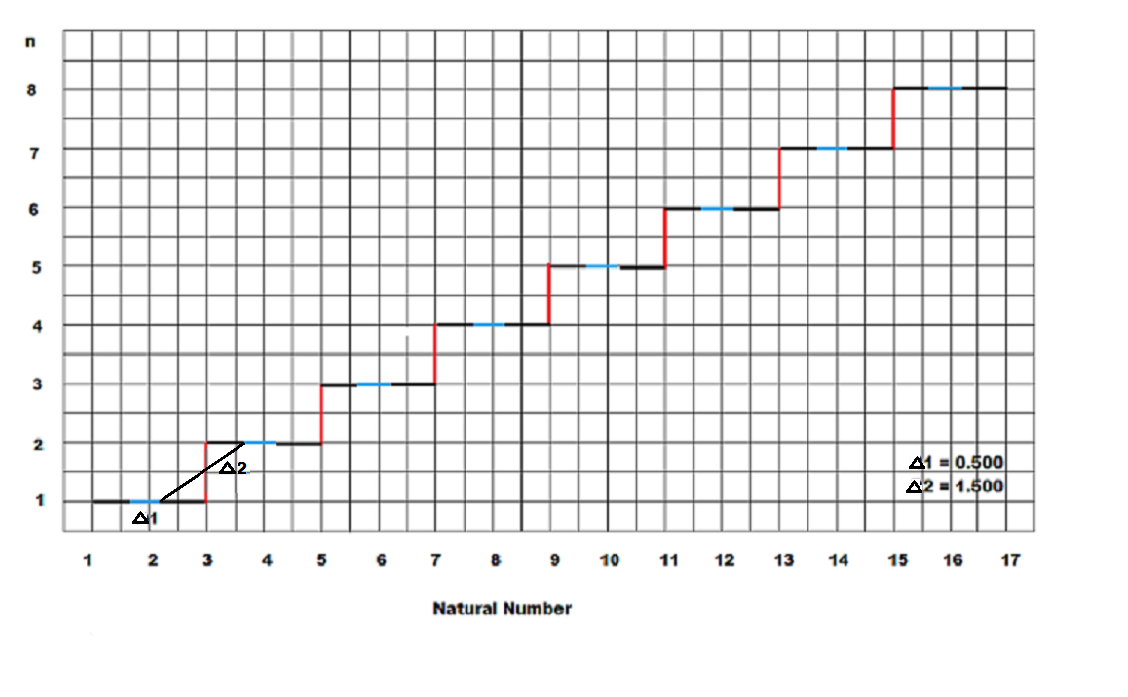
If the natural numbers are plotted on a grid vs n the following picture of a staircase is obtained. The blue lines are the Δ1 differences of 0.5 within the run of the staircase, while the black diagonal, is the difference Δ2 of 1.5; the red, in addition, is a jump from one level to the next (the rise of the staircase).
Is still possible to write out the as one line sequence (for the first ten natural numbers, in red):
However, while when we look at the sequence in this way (as a ramp), there's no way of knowing if the sequence is a staircase or a ramp like the sequence derived from √xy in Part I which has no n levels. The Δ1 and Δ2 can still be read off as well as the differences between a natural number and the Δ1 to its right which approaches 0.25 and 0.75 for a pair of natural numbers. In the staircase sequence the n is required in order that the irrational numbers fall between their two adjacent natural numbers. It wasn't expected that the irrational numbers fell right smack-dab in the same general areas as shown in the figure. In addition, connecting all the 0.25 terms together and all the 0.75 terms together gives "rise" to two parallel ramps where the sequence may have both ramp and staircase properties depending on the view.
Go back to Part VIIa and Part VIIb for proof by induction for and Part VIIb for √n(−(x ∕ y) + x + y).
Go to Part I or Part IV for non-staircase methods. Go back to homepage.
Copyright © 2026 by Eddie N Gutierrez. E-Mail: enaguti1949@gmail.com