The Sierpinski triangle, Wikipedia, and the Sierpinski square also in Wikipedia, are fractals with the overall shapes of either an equilateral triangle or a square, subdivided recursively into smaller equilateral triangles or squares. Part I showed that a square could also behave similarly to afford a new type of fractal. Applying the method of recursive subdivision to a trihexagon affords a new type of mingled (intermixed) fractal composed of three hexagons and three rhombuses.
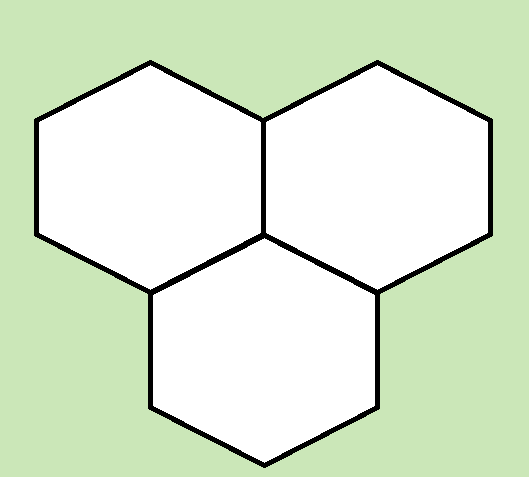
The figure to be subdivided is the following trihexagon:
Working with one of the hexagons in order not to overcrowd the figure we obtain the first iteration by taking one of the hexagons and connecting the opposite vertices and forming R the circumradius equaling the side length of the hexagon t:
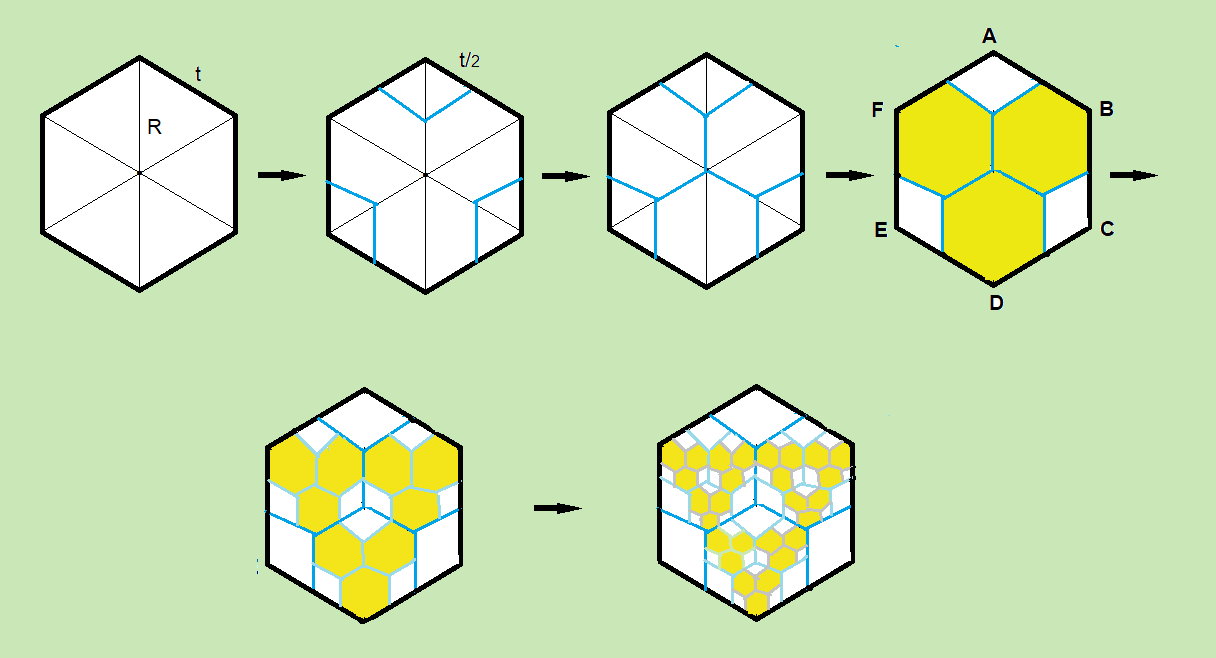
Three identical rhombuses are then formed by intersecting three of the sides as shown in the second structure. Three lines of equal length each separated by angles of 120° and then joined at the center, a structure which I call trigonal planar (TP) based on the similar chemical structure connecting three atoms with a central one Wikipedia. This TP is then joined to the rhombus at the vertex that points towards the center of the hexagon.
Removing the Rs and labeling rhombuses/hexagons as A,B,C,D,E and F at the vertices as shown, where B,D and F are identical hexagons colored gold to distinguish them from the rhombuses A,C and E but also to discern the hexagons from the rhombuses as they shrink in size as the number of iterations increases. Note that the figure has gone thru three iterations.
Performing a fourth iteration affords the figure below with a total number of 81 hexagons at the fourth iteration.
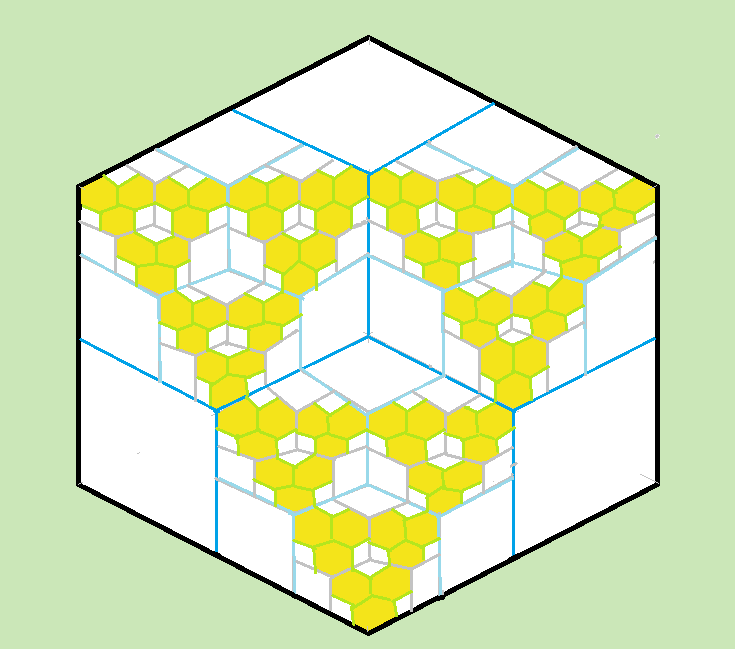
Since there are three hexagons in the original figure a total of 81×3 = 243 hexagons are generated:
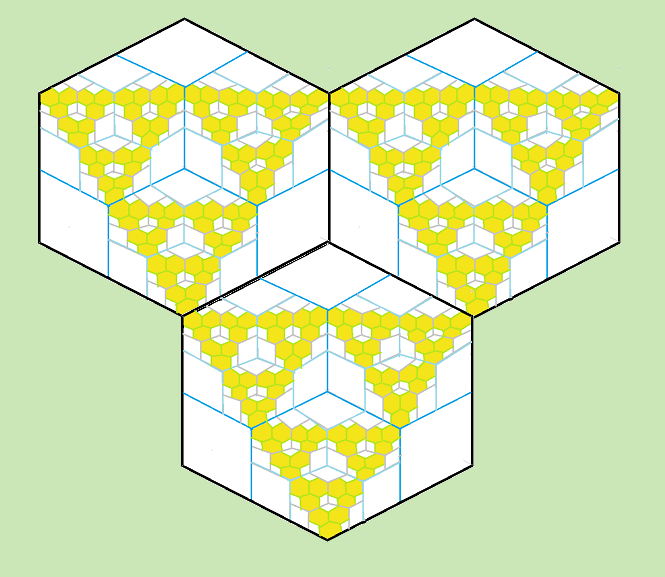
As the figure shows the trihexagon (black border) forms a yellow Sierpinski triangle composed of hexagons. In addition, the cubes, starting with the largest ones at the bottom, appear to be receding upward into the vertical direction with cubes stacked one over the other generating an infinite mirror effect. Moreover, the figure looks as if a Sierpinski gasket with its accompanying holes is placed upon a background of cube-like marshmallows. The result are cubes peering thru the holes of what appears to be a transparent gasket.
Performing an iteration on the one hexagon affords the following set, a set dissimilar from the regular Cantor set:
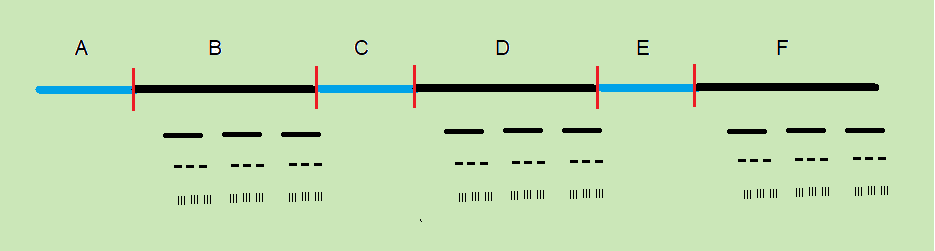
where the original trihexagon is shown as a black line which is subdivided in the first iteration, into three smaller line segments. In rows three and four the subdivision process is repeated using shorter line segments.
Go to Recursion of Part III dioctagon fused to an irregular hexagon.
Go back to homepage.
Copyright © 2026 by Eddie N Gutierrez. E-Mail: enaguti1949@gmail.com