
The Sierpinski triangle, Wikipedia, and the Sierpinski square also in Wikipedia, are fractals with the overall shapes of either an equilateral triangle or a square, subdivided recursively into smaller equilateral triangles or squares. I have found that initially subdividing a square into four squares two of which are 90° triangles each having two equal sides and a diagonal in a ratio of 1:1:√2 and two regular squares, then subsequently performing recursion, can lead to a new type of mingled (intermixed) fractal.
To get the first iteration we start by taking a tilted square and bisecting each side four times to form four smaller squares, two of which are bisected by blue diagonals:
The four smaller squares of figure Square I are subsequently labeled A,B,C and D and B and D are colored gold to distinguish them from A and C but also to discern the squares as they shrink in size as the number of iterations increases. Alternatively, the four squares can be constructed as on the right (Square II):
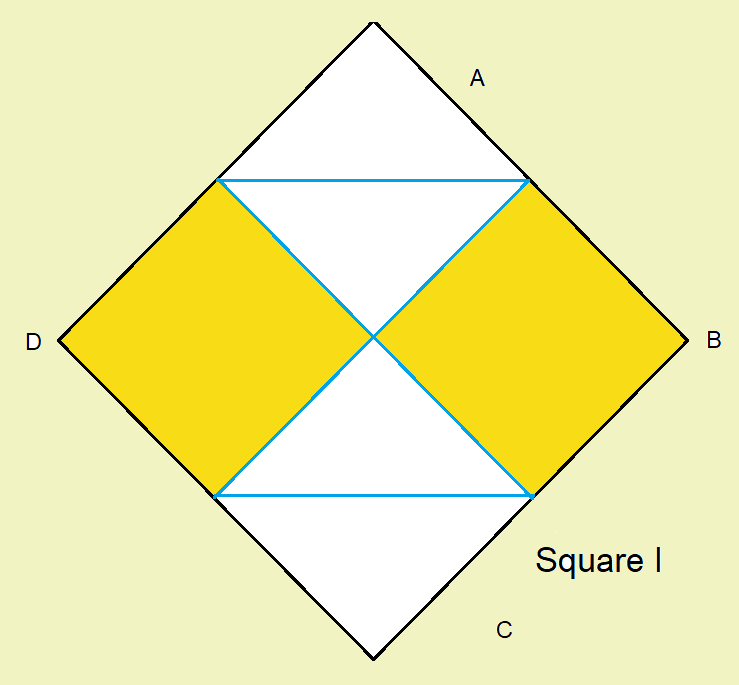
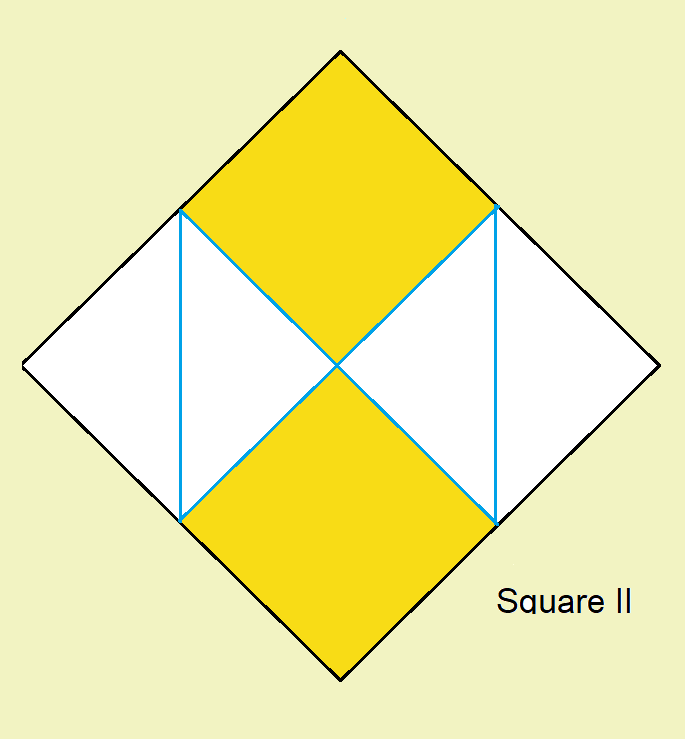
Performing an iteration on Square I affords two types of subsquares: squares A and C follow a regular Sierpinki recursion, while B and D undergo a recursion where both sets of squares involve a slightly dissimilar regular Cantor set:
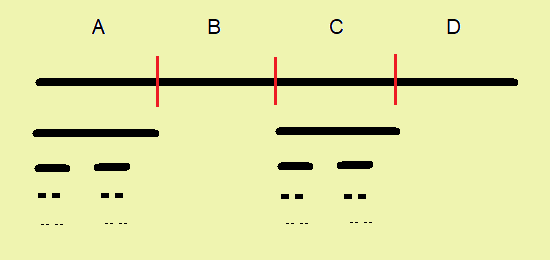
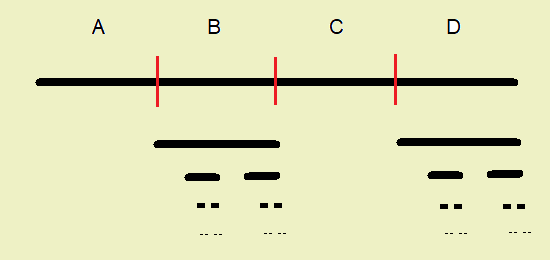
where the original square is shown as a bold line composed of the four line segments standing for squares A,B,C, and D after the first iteration. Since A and C belong to the triangle group and B and D to the square group these form their own cantor type groups as shown. In both cases the appropriate line segments are removed from each row as the process is repeated using shorter line segments.
And as shown where the number of golden squares doubles each time a recursion occurs, while the accompanying A and C squares being generated at each iteration undergo Sierpinski subdivision.
The effect of subdividing Square I recursively by performing two, three and four iterations affords:
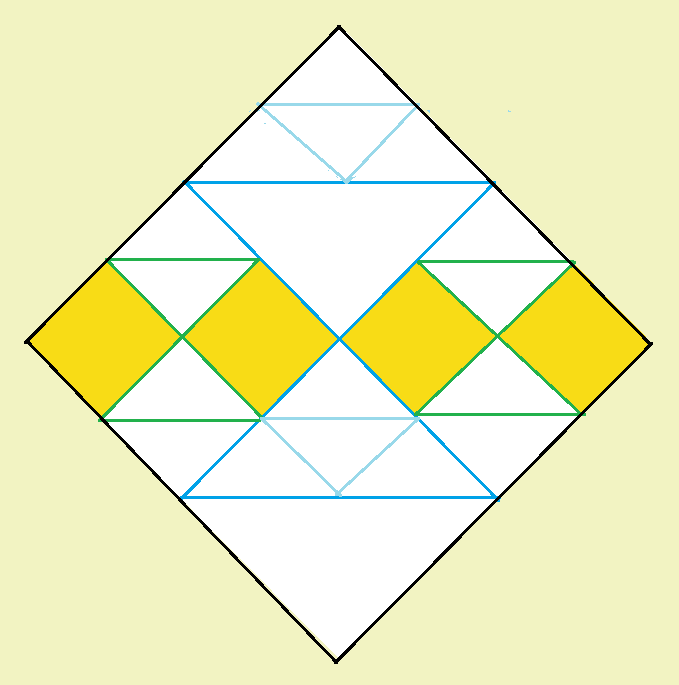
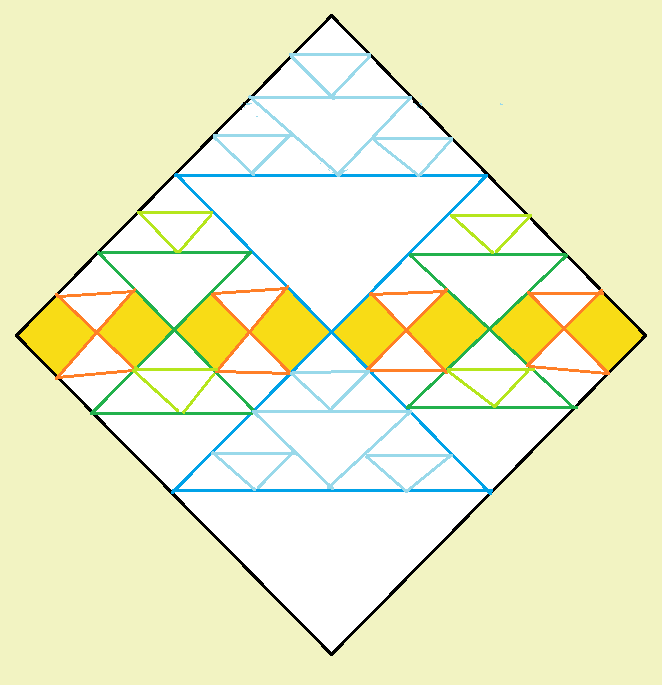
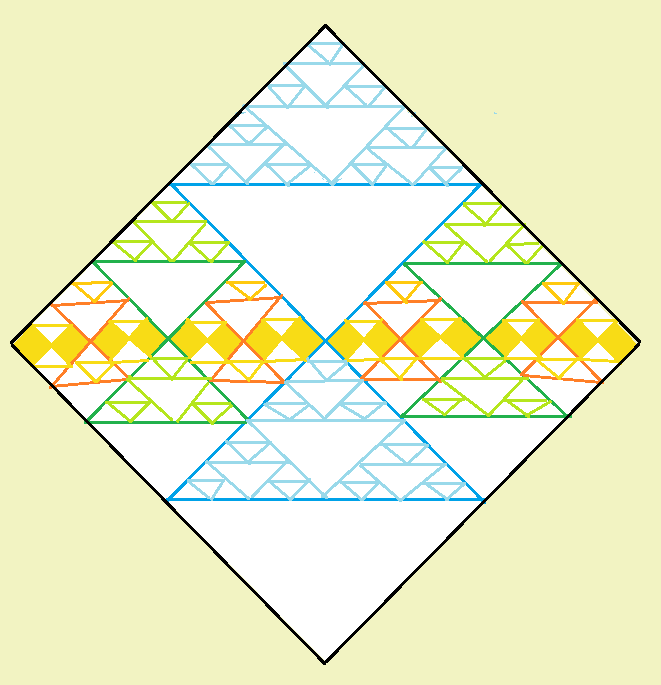
where the color of the diagonals at iteration three changes to orange to distinguish it from the blue and green diagonals.
And finally in a fifth iteration where only square B (enlarged) is shown, to afford:
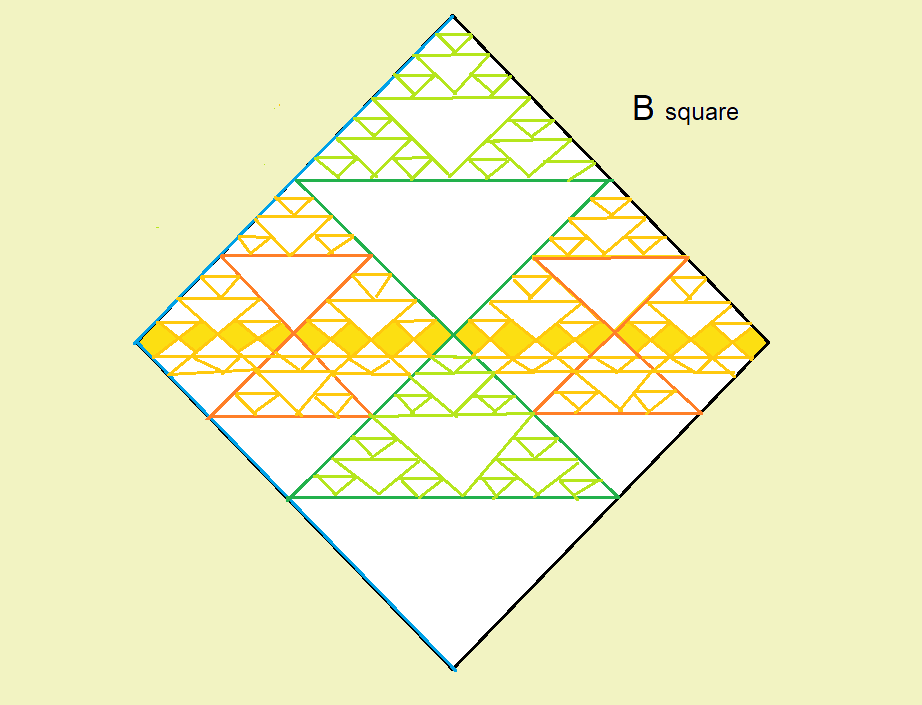
Since B and D are equivalent, the fifth iteration would show a total of 32 golden subsquares. On the other hand, the fifth iteration of A or C are not shown since these are just the iterated blue 90° Sierpinski triangles.
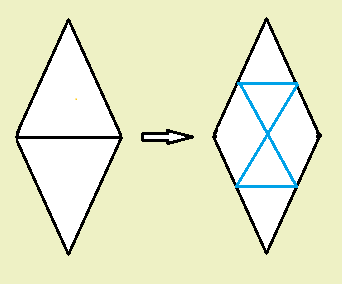
In the above case for simplicity a square was chosen for the various iterations. However, other quadrilaterals may be used, for example taking 2 equilateral triangles and fusing them to form a rhombus (after removing the diagonal) and which after the first iteration affords:
To go to Part II a novel hexagon fractal.
Go back to homepage.
Copyright © 2026 by Eddie N Gutierrez. E-Mail: enaguti1949@gmail.com