The Sierpinski triangle, Wikipedia, and the Sierpinski square also in Wikipedia, are fractals with the overall shapes of either an equilateral triangle or a square, subdivided recursively into smaller equilateral triangles or squares. Part I and Part II showed that both a square and a hexagon could also behave similarly to afford a new type of fractal. When the method of recursive subdivision is applied to series of trioctagons, a Sierpinski triangle of trioctagons, a new type of recursive structure, is generated. The technique employed, called the Droste effect, is the effect of a picture recursively appearing within itself much like video feedback.
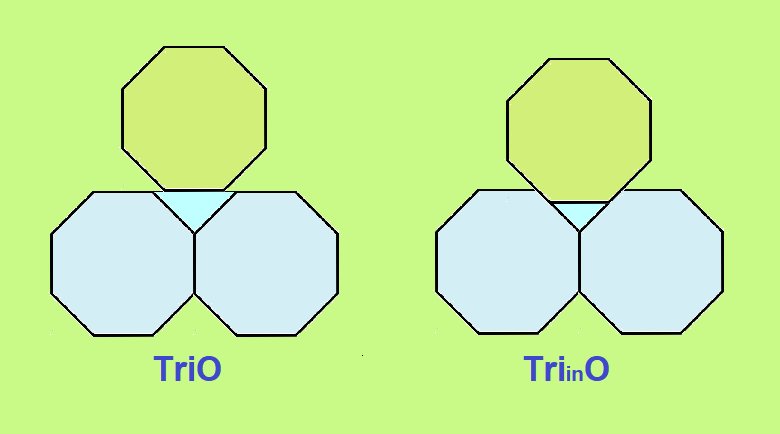
We begin by taking three octagons in two different orientations TriO and TriinO, the first has one octagon level to each of one side of two octagons and the other within the space where the two octagons are joined. In TriO if a side of an octagon is equal to one then the side of the blue triangle where the octagon sits (from the vertex of one octagon to the other) is equal to √2. While in TriinO the blue triangle is a 1,½√2, ½√2 triangle. Consequently, an infinite number of triangles will fit in this area as long as the distance between the blue octagons is:
TriO and TriinO just happen to be the extreme cases.
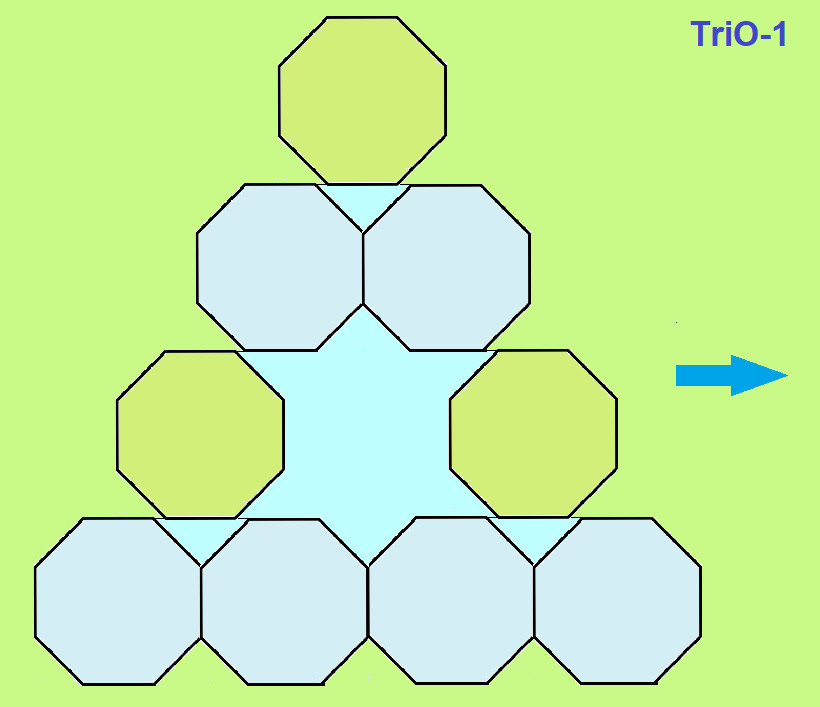
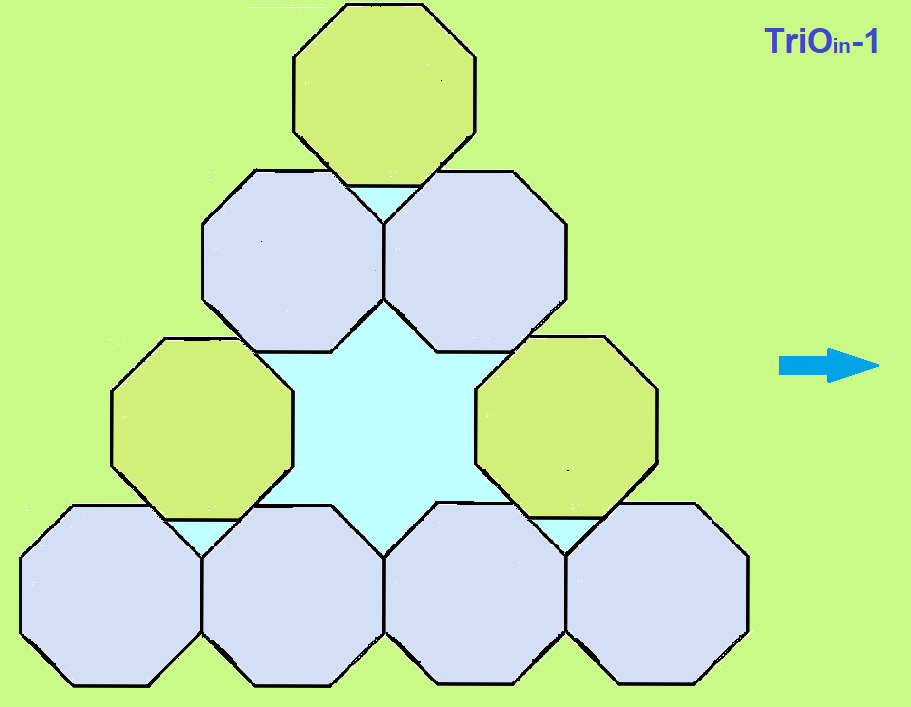
Stacking one TriO over two TriOs affords TriO-1, containing a six membered star between the stacks, and performing one recursion of TriO affords TriO-2. Note that stacking for options one and two, follows the same path as the trioctagons. The trioctagon can just touch the star or enter the star, decreasing in size as the trioctagon pushes into the star.
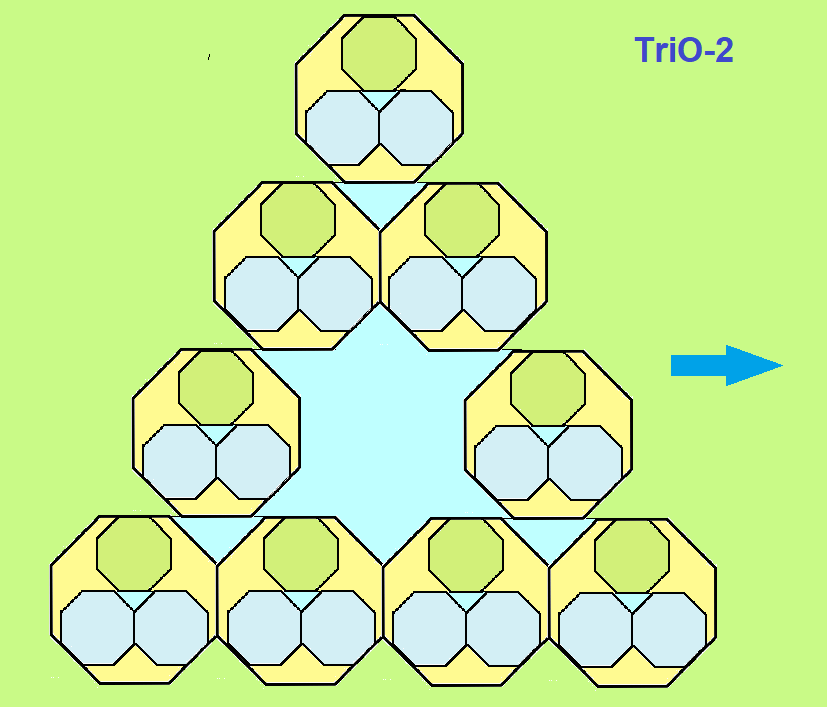
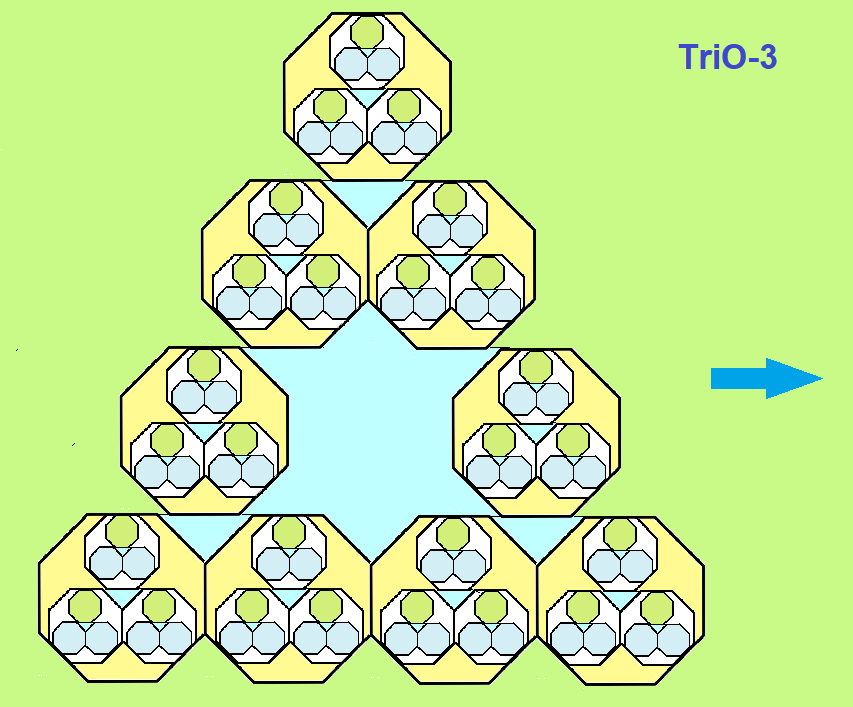
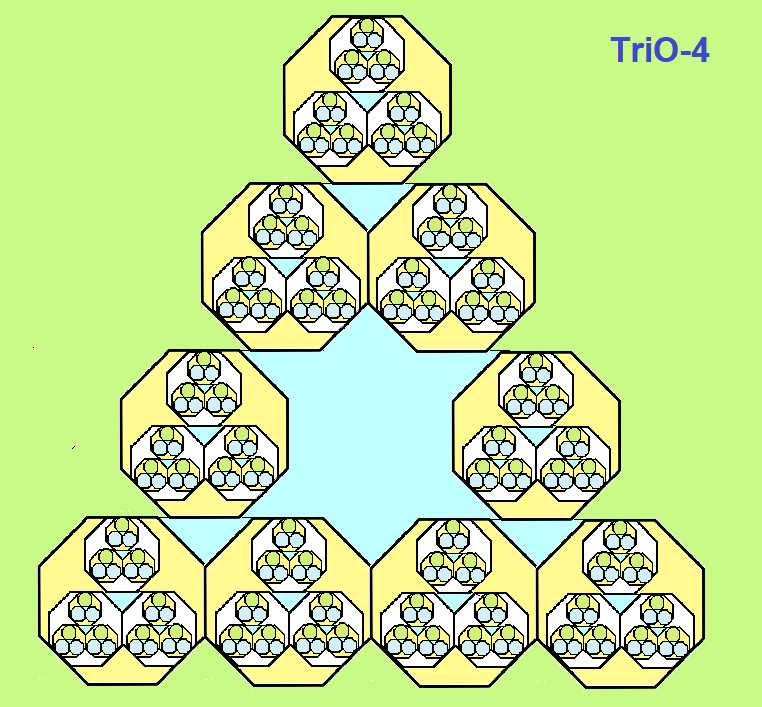
Performing a second and third recursion of TriO affords TriO-3 and TriO-4. The result is a Droste effect where smaller pictues of the trioctagons keep appearing within themselves.
Starting with TriinO and stacking one TriinO over two TriinOs affords TriinO-2, containing a six membered star between the stacks, and performing one recursion of TriO affords TriO-2.
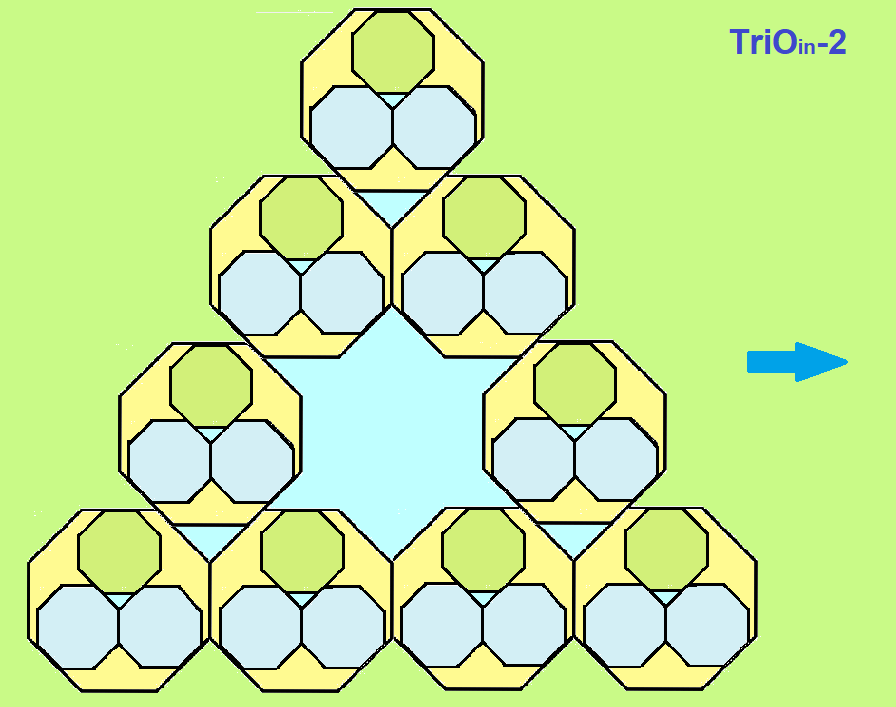
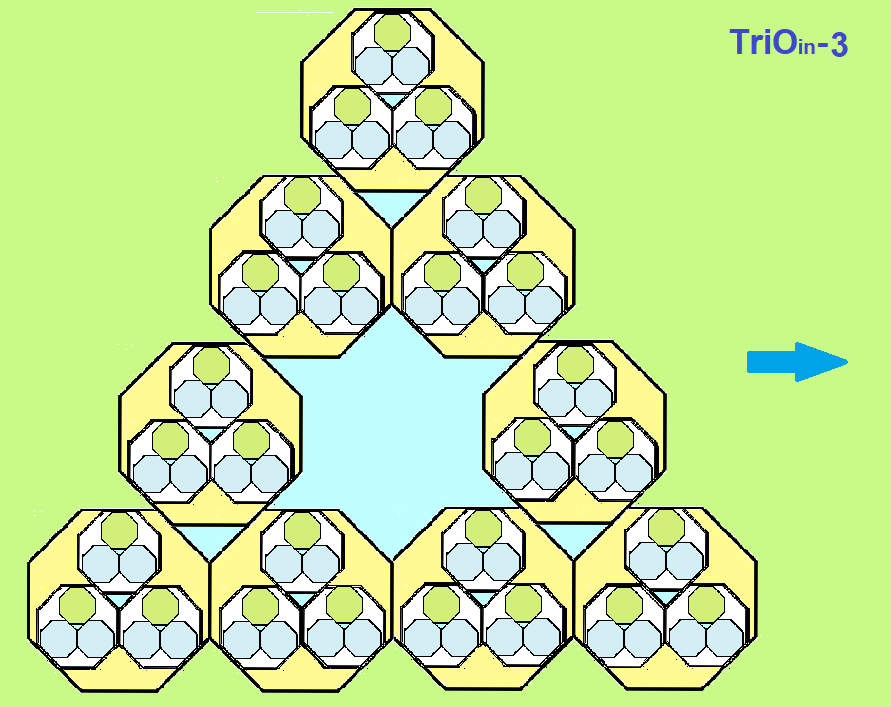
Performing a second and third recursion of TriO affords TriinO-3 and TriinO-4. The result again is the Droste effect.
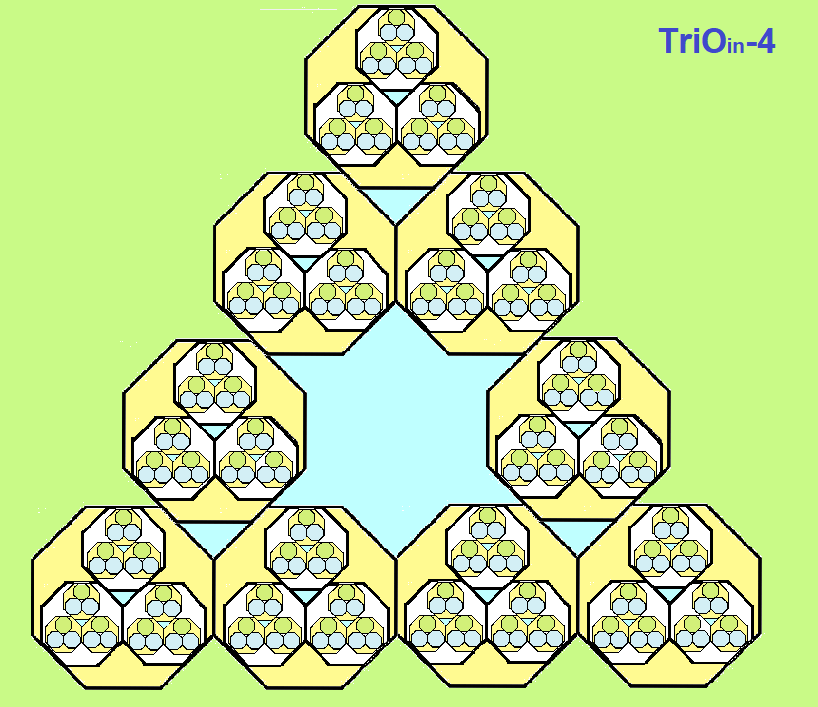
In addition, using only the three groups (triad) of option one, a better resolution of the Droste effect is possible.
01.png)
02.png)
The difference with option 1 and option 2 is the position where the tri-octagon sits over the bottom two octagons. Everything looks the same, with all of the sub/sub octagons lining up identically in the figure. As stated above the blue triangles generated (as well as the six membered star) must sit between two limits so that all the figures appear similar, lining up to afford the Droste effect and what appears to be the beginning of a Sierpinski triangle.
Performing one further recursion gives a better view affording, first with the colors employed in this paper and second with the colors consistent with previous Sierpinski triangles sort of like making a photographic negative of the left hand figure, for example T-5 in Part IIb, an obstructed trioctagon :
03.png)
04.png)
Furthermore, the holes in the triangles are filled with a triangle/three boats which may or may not be present with other smaller boats in order to fill up the holes.
Go back to homepage.
Copyright © 2026 by Eddie N Gutierrez. E-Mail: enaguti1949@gmail.com