The Sierpinski triangle, Wikipedia, and the Sierpinski square also in Wikipedia, are fractals with the overall shapes of either an equilateral triangle or a square, subdivided recursively into smaller equilateral triangles or squares. Part I and Part II showed that both a square and a hexagon could also behave similarly to afford a new type of fractal. When the method of recursive subdivision is applied to series of octagons a new types of recursive structure is generated. The technique employed, called the Droste effect, is the effect of a picture recursively appearing within itself much like video feedback.
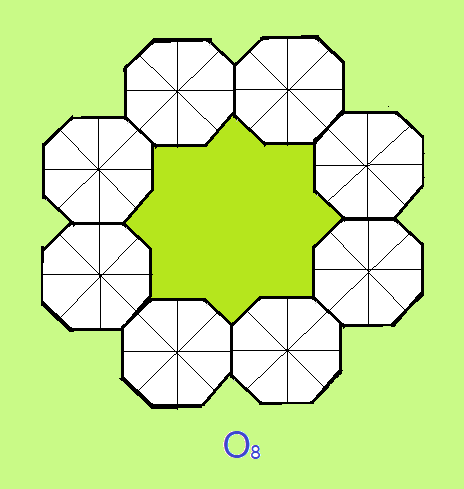
We begin by taking the cyclic octagons (O8; my designation) which is an available online structure consisting of eight smaller octagons surrounding an eight pointed star (in green). The math paper and its accompanying you tube video containing (O8) was used in calculating the area of the eight pointed star. The present page, however, uses recursion on all of the octagons and a way of determining the area of the octagon derived by the eight pointed star as shown below. Two options will be used: either to (a) deconstruct the eight pointed stars (an irregular octagon) into its constituent parts viz. an octagon and eight identical triangles, or to (b) leave the star untouched and just fill in the white octagons recursively with O8.:
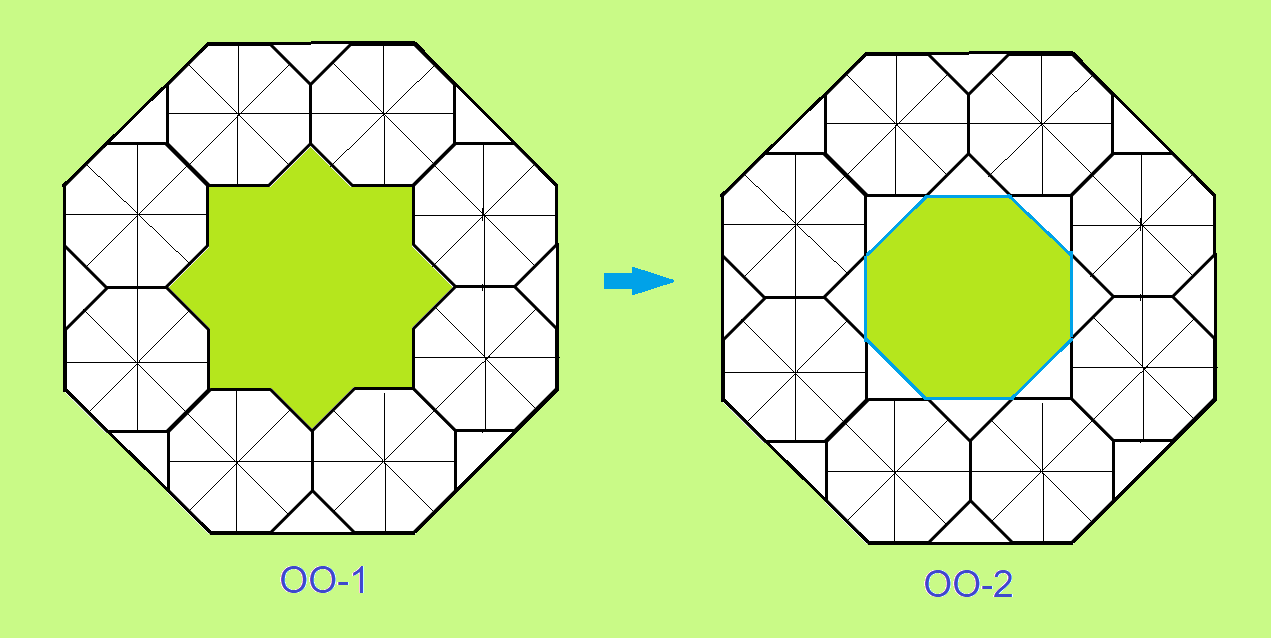
Inserting the figure O8 into the octagon affords OO-1. The eight pointed star in the center of the figure of OO-1 is subsequently converted into the eight white triangles and a blue lined octagon structure of OO-2 where the green octagon is larger than any of the white octagons on the perimeter of the large black outlined octagon. It will be shown that the triangles derived from the tips of the star as well as the perimeter triangles are congruent: go to Octagon Areas Calculation.
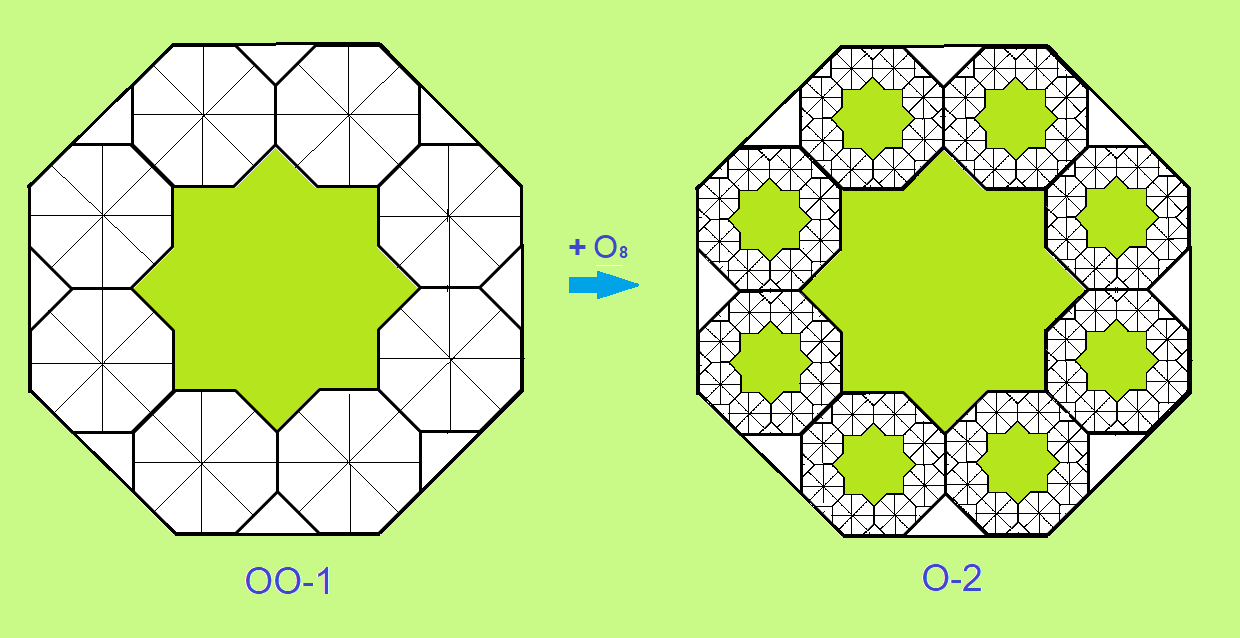
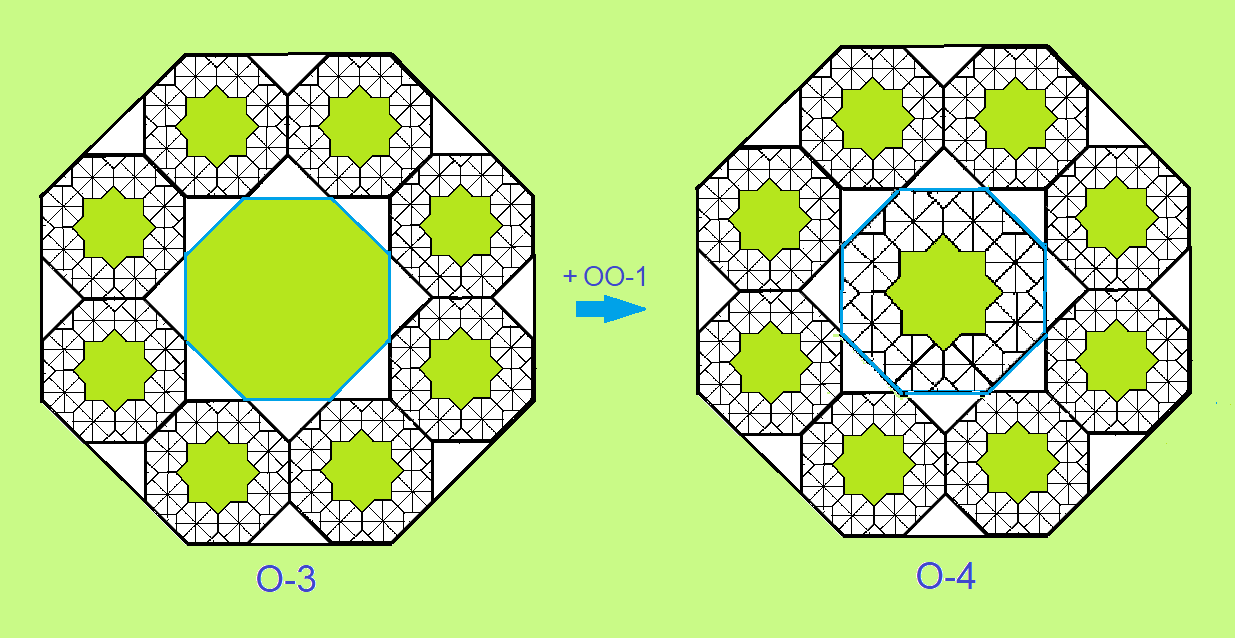
There are a several ways of performing the recursions. One is to take OO-1 and to add O8 to it. This generates O-2. Subsequently, using the color blue, we delineate the internal octagon to form O-3.
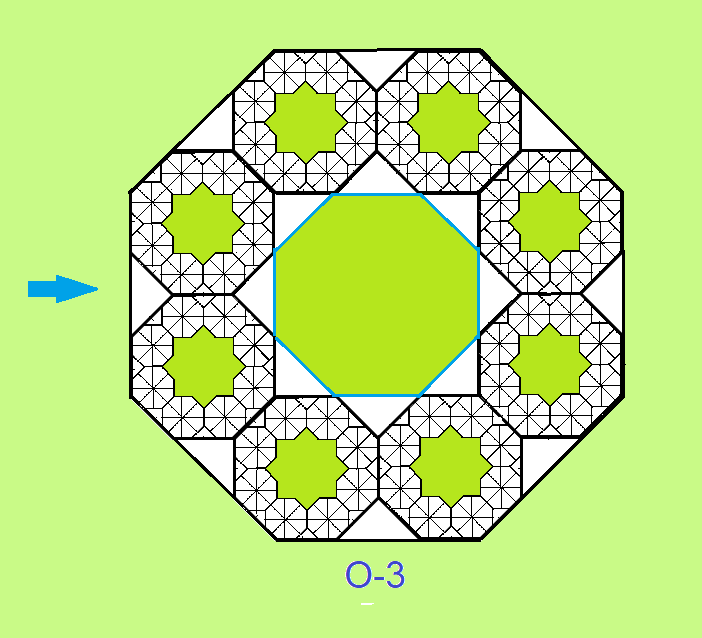
Subjecting the inner octagon of O-3 to a recursion affords O-4.
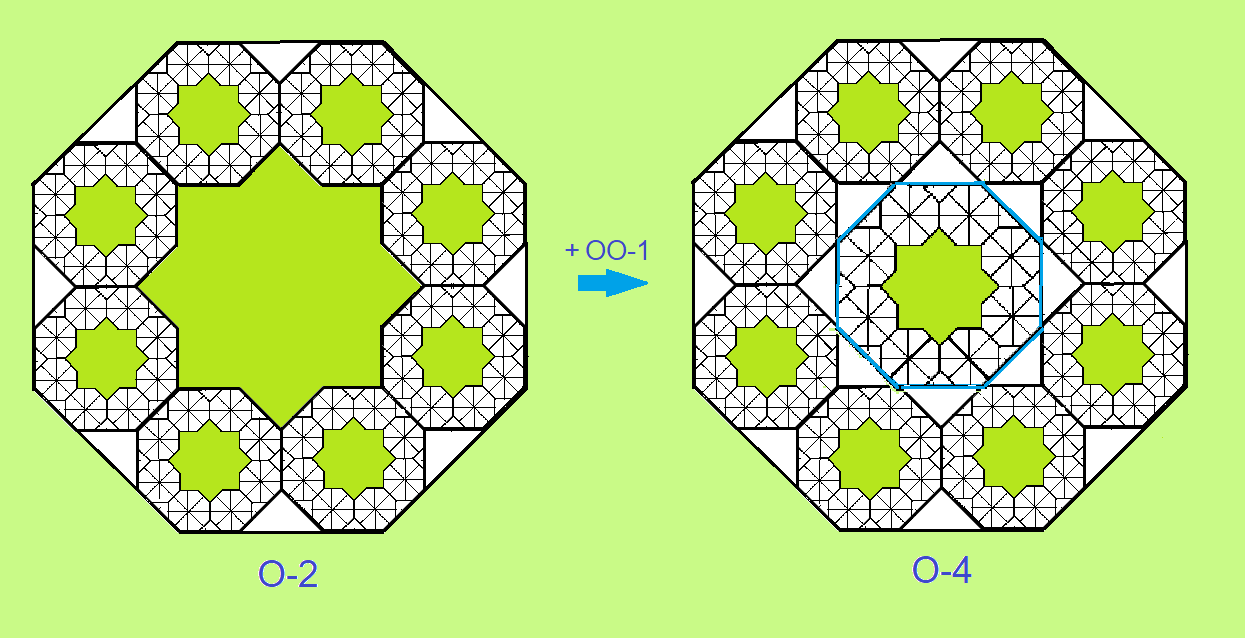
Alternatively adding OO-1 to O-2 (with the generation of white triangles), then outlining the border of the internal octagon in blue affords again O-4.
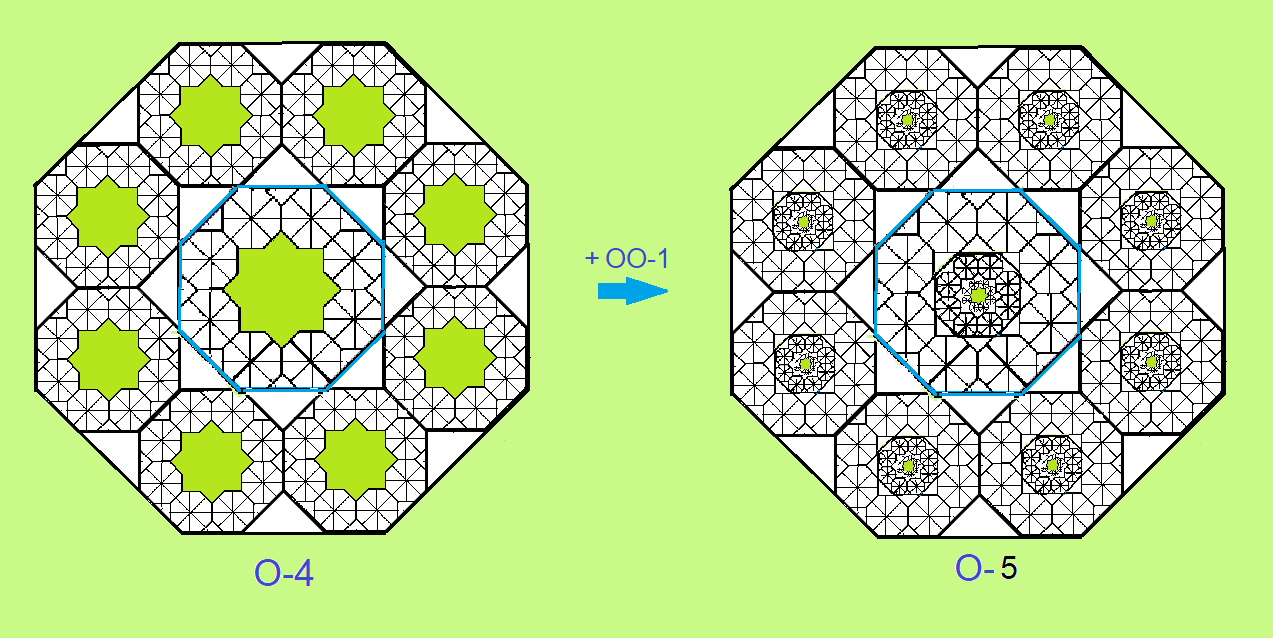
A third recursion in one step for all octagons involved by adding OO-1 to O-4 affords O-5 with the resolution getting worse as recursive subdivision increases.
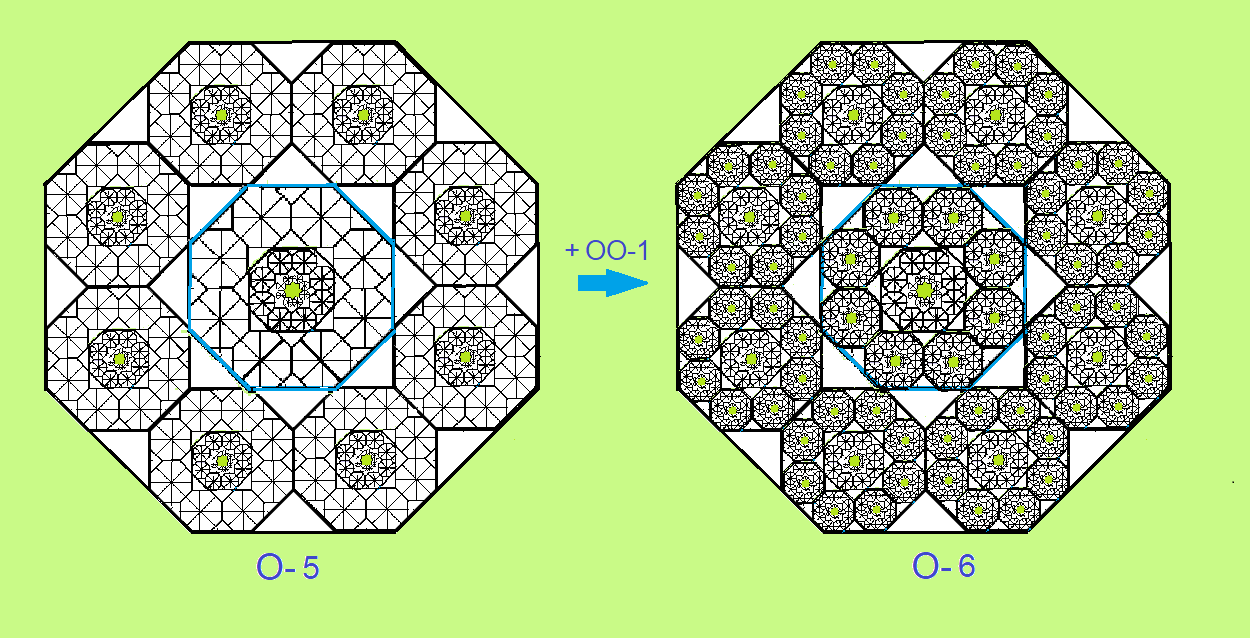
Performing a further recursion on both white octagonals (small and large) of O-5 affords the figure below.
In option 2 the eight point star is kept untouched and only the white octagons are filled in recursively:
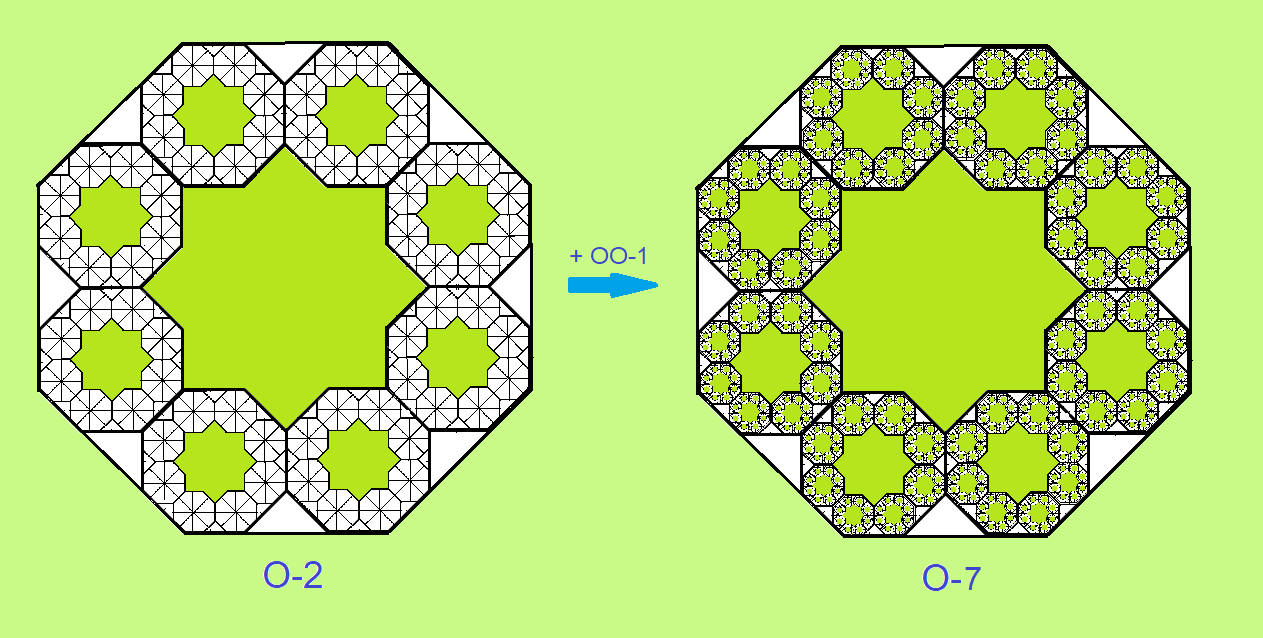
Consequently, depending on how elaborate the recursive structure desired, one may pick between either O-6 or O-7 using the methods employed here.
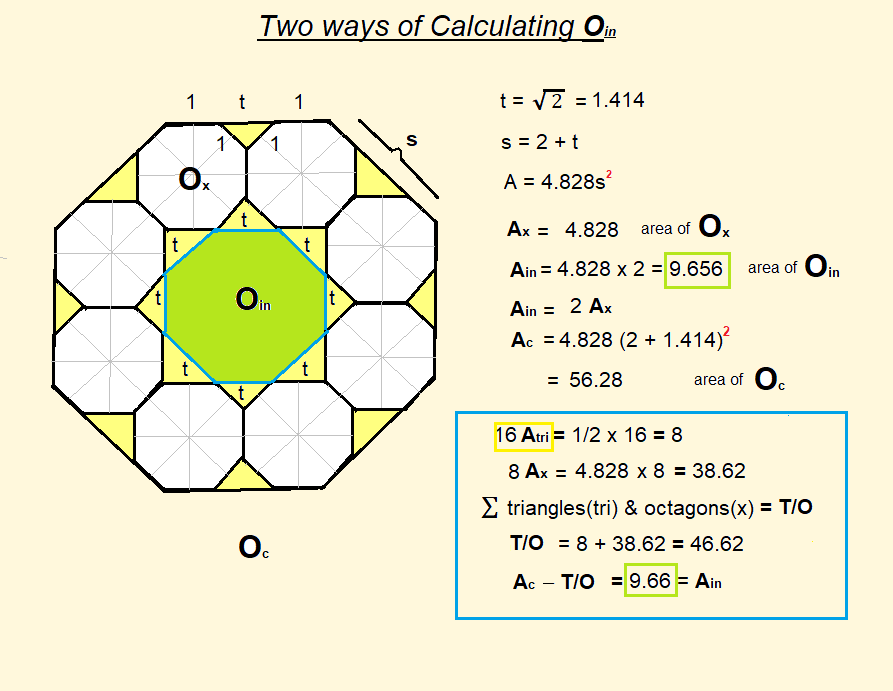
The area of the internal octagon (Oin) in option 1 can be calculated by two different route as shown below using the formula 4.828s2 where s is the side of an octagon. In the example shown, the sides of the white octagons are taken to be one, making the area of a yellow triangle (a 90°, 45°, 45° triangle) equal to 0.5. Therefore, every hypotenuse t is equal to √2 and the side of the large octagon (s) = 2 + √2. Consequently, the area of the large black outlined octagon Oc = 56.3 while that of blue outlined Oin is found to be 9.7 via two methods. The calculation shows that the area Oin is twice as large, as the area of one of the white octagons, Ox.
So that whenever a recursion occurs the images within Oin will show up larger than those in Ox. Consequently, the size of the image generated during a recursion, is variable as was shown in the conversion of O3 to O4. The same can be said of O4 to O5 using a magnifying glass.
Go to the trioctagon analog Part V.
Go back to homepage.
Copyright © 2026 by Eddie N Gutierrez. E-Mail: enaguti1949@gmail.com